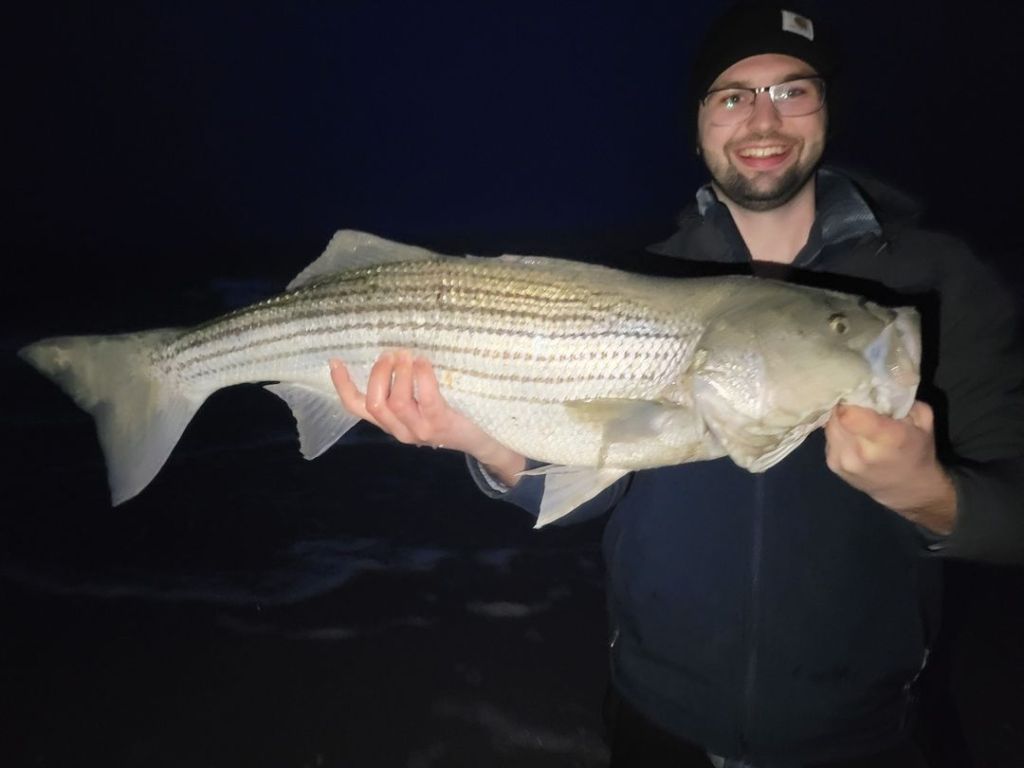
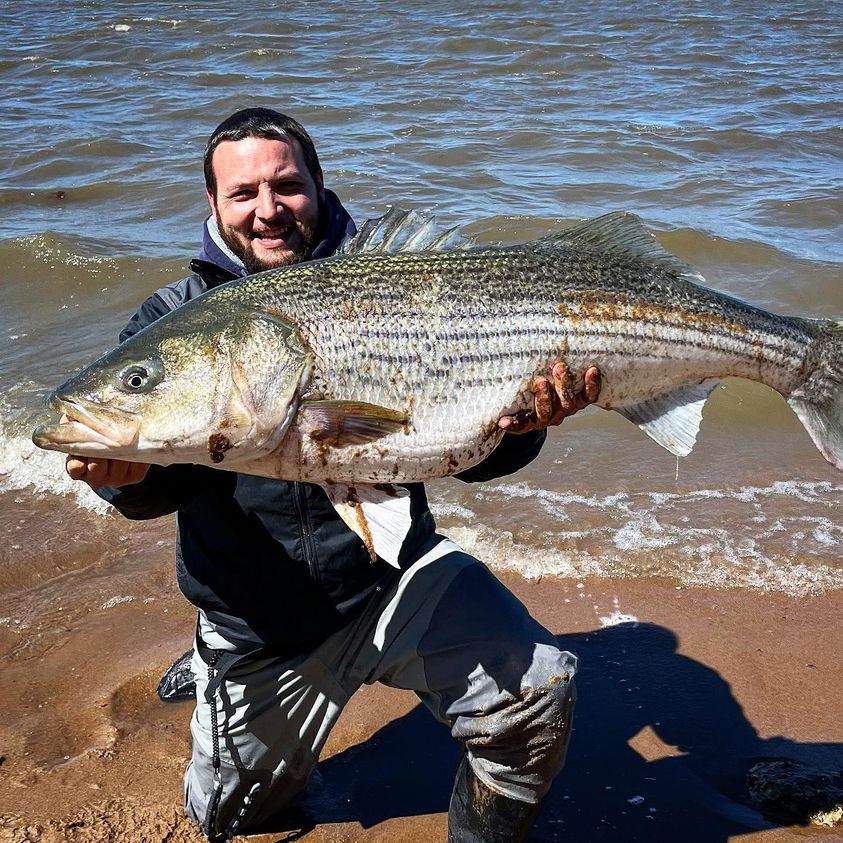
Comparing big stripers is difficult these days as all big ones have to be released. Yet, I haven’t seen any release photos to compare with the bass released by Doug Taylor of Milleville, N.J. which Higbee’s Bait & Tackle says is the largest ever caught from Fortescue beach. Not only was it 55 inches long, but it also had a huge girth.
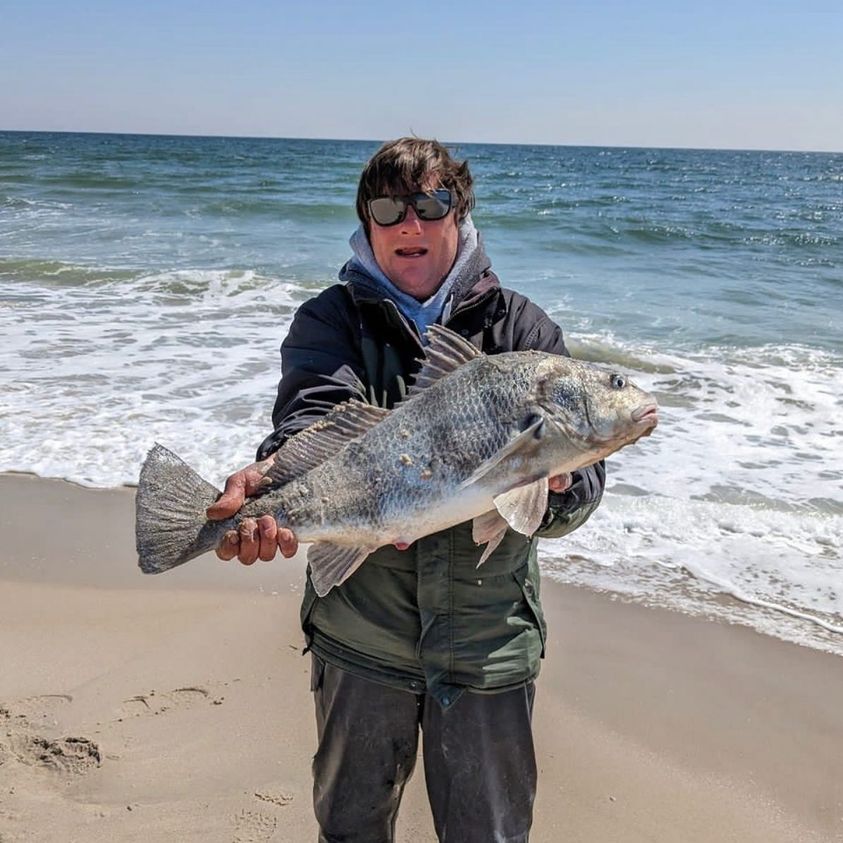
Not nearly as large, but a sure sign of spring on the beach was this black drum caught by Jamie Gramley in a photo submitted this week by Betty & Nick’s Fishing Club in Seaside Park.
There’s another good forecast for Tuesday as the day starts with just west at 10-15 knots before increasing to southwest 15-20 in the afternoon.
The Ocean Explorer from Belmar reported Monday’s bottom fishing was tougher due to a large swell, though some cod were caught along with tog. The Big Mohawk from that port reported good bottom life with the high hook catching a limit and blackfish up to 7 pounds.
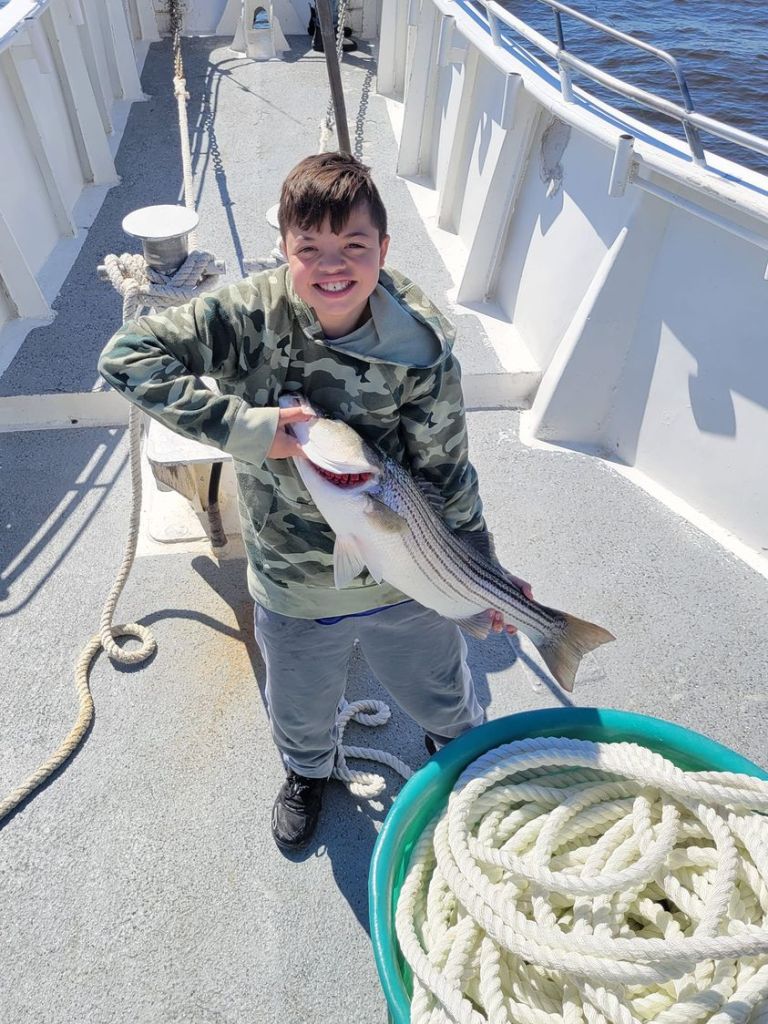
Ryan Class has been waiting years to catch his first legal striper before coming up with this one at the north end of Brigantine — and then releasing his prize. Riptide Bait & Tackle reported the catch made on salted clams.
Northern N.J. striper fishing was off this morning, but Capt. Michael Ardolino’s son broke the ice on Miss Belmar Princess
There’s a great forecast for Tuesday – west at 10-15 knots before going southwest at 15-20 in the afternoon.
While party and charter boats along the NJ Shore are waiting for ocean striper fishing to break open, they have been able to get by with decent fishing for blackfish and cod.
At Belmar, the Golden Eagle reported a slow start Saturday before they hit two wrecks which produced tog up to 7 pounds along with lots of shorts.
They’ll be out there again at 7:30 tomorrow.
The Big Mohawk reported a strong current down the beach on Saturday resulted in a slower bite though the high hook had a limit and tog up to 5 pounds were boated along with a few cod.
The Ocean Explorer noted that Good Friday was good to them as tog up 6 pounds responded despite a strong current.
Capt. Joe Massa ran his My Three Sons from Morgan Marina out to 17 Fathoms on Saturday for cod and tog, but found too much dogfish competition out there before moving closer to shore for the same species.
Monday’s forecast is great — west at just 5-10 knots.
I wonder how many of my readers remember when it is was possible to fish for winter flounder from a Raritan Bay party boat?
After opening one of my yearly fishing notebooks, I can assure you that was possible in 1989 as on April 7 of that year I fished aboard the Fishermen from Atlantic Highlands with Captains Ron Santee Sr. and Jr, on the clam beds off Staten Island — and caught 29 flounders!
There were no restrictions all on winter flounders in those days, but my notes broke down that catch into two tiny 8-inchers, two of about 10-12 inches – and 25 of the present 12-inch (and then minimal filleting size of 12 inches) which included four of 2 pounds and a 2 1/2-pounder.There were two chum pots down, and it was important to fish close to them as bloodworms, black mussels and skimmer clam all produced bites. According to my notes, I was high hook, but another angler caught 12 to 15 while “Ron Sr. must have caught 18-20 while fishing part time.”
Other party boats were also opening the season with winter flounders at that time before striped bass made such a comeback that that clamming for them became the April attraction.
It should ne noted that private boaters chumming heavily often had catches of over 100 flounders at that time. Even if flounders were able to overcome commercial pressure on their summer offshore grounds plus an abundance of seals inshore from Climate Change that was supposed to send them in the opposite direction, it would not be practical for a party boat to fish for flounders now with a two-fish per angler limit.
The Sunday forecast is for northeast winds at only 10-15 knots before going east in the afternoon with two-foot seas.
At Belmar, the Big Mohawk reported good Friday morning bottom fishing with lots of short tog plus some keepers and a few cod.
There were several reports today of a tougher early striper bite in Raritan Bay this morning, though most anglers seemed to end up doing well.
Andreas Toy from Perth Amboy reported the 31-footer covered a lot of ground early before getting into a good bite with bigger bass ranging up to a 42-incher. Most of the bass were caught on flutter spoons along with a couple on shads.
Saturday’s forecast is for north winds at 10-15 knots plus gusts to 20 before switching to southwest at 10-15 knots in the afternoon.
In a surprising move, N.J. Governor Phillip Murphy has replaced Tom Fote as the state’s governor’s appointee to the Atlantic States Marine Fisheries Commission (ASMFC) with a lobbyist, Jeffry Kaelan, for Lund’s Fisheries in Cape May.
Fote has been serving in that voluntary position under governors of both parties almost continuously since 1990. He was in a position to provide the huge amount of time involved because he’s a disabled Vietnam veteran living on a pension that doesn’t permit any other working income. As a longtime officer of the Jersey Coast Anglers Association, he’s been involved with fisheries conservation issues for decades. Furthermore, his long tenure at the ASMFC put N.J. in a strong position within the association as “knowing where the bodies are buried” is often the difference between success and failure during fisheries debates.
Worst of all, Fote’s replacement isn’t another strong conservationist, but rather a man on the pay roll of a powerful commercial fishing business. Kaelin would be well qualified to serve as the state’s commercial member on the delegation — but not as one representing the public,
Gov. Murphy had signaled his attitude toward marine conservation when he selected the Speaker of the Assembly to run with him as Lt. Governor after she had left no doubt where her interests where when she wouldn’t allow a bipartisan bill to prevent commercial gear on inshore reefs to be voted on despite the bill having more than enough sponsors to easily pass.
The forecast is for northwest winds at just 10-15 knots.
At Belmar, the Capt. Cal 2 starts blackfisihing daily at 7:30 Saturday. An Easter morning trip will be run from 6:30 to 12. Capt. Matt Sosnowski has been added to the crew of tog pros.
Miss Belmar Princess will be seeking stripers daily at 7:30 Saturday.
The Golden Eagle will be bottom fishing while hoping to find stripers as they did Sunday — though those bass wouldn’t hit.
The Misty Morn from Morgan gets started with a 7 a.m. trip for stripers on Saturday .
At Brielle, the Paramount will be running for tog and cod at 6:30 Saturday.
The Vitamin Sea from Keyport had bass up to 42.5 inches Wednesday, and may have open boat spots Friday and Saturday afternoons plus Easter morning.
Fisher Price IV from Highlands had a problem finding bass in low visibility until their screen lit up!
Will Hoffman released his largest striper so far this season– a 40-incher.
Raritan Bay water temperatures are finally warming up, and the already great striped bass bite seems to be getting even better.
That’s the consensus from many reports, and Capt. John Contello summed it up on his Just Sayin boats as follows:
*Next Open Boat Sunday Easter morning (Back by Noon)* Private charter availability text 732-670-1919
The fishing could not be any better this morning! As good as it gets eating everything we put in the water! Both boats filled the boxes quick and played catch and release all morning with several fish in the 40” class!! These fish are here and fired up!
Chuck Many concentrated on looking for big bass yesterday with his Tyman from Highlands — and as is usually the case that’s exactly what his crew did.
Capt. Vinny Vetere has plenty of time to get ready for the N.Y. season, but did some exploring yesterday with his Katfish from Great Kills and released a 42-pounder on a live bunker.
The Golden Eagle from Belmar will be running a bottom fishing trip at 7:30 a.m. — unless they come across stripers in the ocean. Also at Belmar, both the Big Mohawk and Ocean Explorer have been finding a lively bottom bite with some keeper blackfish plus lots of shorts and a few cod.
A dense fog warning is up until 6 p,m. — followed by a small craft advisory to Thursday afternoon. The forecast is for south winds at 10-15 knots with gusts to 20, There may be afternoon showers or even a thunderstorm.
It was only yesterday that during a casual conversation with a fishing friend that I became aware that famed outdoor writer Milt Rosko had passed away at 93 last November.
Born and raised in Newark, Milt attended West Side H.S., but lived most of his life in Watchung. He joined the U.S. Marine Corps in 1951, raising to sergeant before getting into the business world as Operations Manager of Annheuser-Busch.
Outdoor writing was strictly a sideline at that time as the compensation was minimal despite the fact that magazines wanted good black and white photos which Milt was able to supply as he had the finest camera equipment at the time. That photography was also vital in producing angling books, and he ended up with 10 published books.
The Rod & Gun Editors of Metropolitan N.Y. were a pretty exclusive organization composed of the newspaper outdoor editors plus the editors of major outdoor magazines , but Milt’s pioneering work earned him a membership. He was just as enthusiastic about writing up night whiting fishing from the old Long Branch Pier as in detailing the new canyon fisheries for tilefish and game fish which anglers weren’t even aware of a few years earlier. Milt did quite a bit of pioneering himself with the Linda June which they even sailed to North Carolina’s Outer Banks one summer.
Milt also had a summer home in Mantoloking, and particularly enjoyed walking the relatively inaccessible portion to cast small lures for stripers, blues and whatever else might hit them before being released. As always, any angler who sought his advice was educated on the spot. Indeed, it was there where I last saw Milt a few years ago when he seemed to be doing well even though he was older than me.
I frequently hooked up with Milt and June (his wife of 69 years) for car rides to outdoor writer and conservation meetings. It seems like just a few years ago that the Fisherman’s Conservation Association of Staten Island arranged a party to present both Milt and I with their Lifetime Achievement Award.
Though Milt is now fishing heavenly waters surely teeming with fish, everyone who ever encountered him was left with positive memories of a man who worked hard to provide good fisheries for the future and who never passed up an opportunity to help others enjoy success in an often frustrating sport.
The forecast is for east winds at just 5-10 knots before increasing to 10-15 plus gusts to 20 in the afternoon.
The Manhattan Cup will be run this year on June 9 with no significant changes from last year.
Anyone wishing to enter their boat or participate individually in this contest for the benefit of wounded veterans should give Gary Caputi a call at 732 740-9982 or e-mail caputifish@gmail.com.
A small craft warning will come down tonight. There’s a strange forecast for the morning with a south wind at only 5-10 knots — but with gusts to 20. That changes to 10-15 knots in the afternoon.
Andreas Toy from Perth Amboy reported Sunday’s open trip started slowly, but improved as the wind flopped out. The high hook jigged 16 bass, and about 25 stripers received Gray tags — bringing them up to over 70 so far. They are open on April 5. Call 732 672-1561 for info.
Fisherman’s Headquarters on Long Beach Island sent this photo of Kory Fishbein with a 46-inch striper caught on bloodworms in the Delaware River before release.
As noted in this blog, it’s often possible to fish “under the beach” in northwest winds as the hills along the N,J. Shore create a calm inshore area. That’s what the Ocean Explorer from Belmar did today, and they had decent tautog fishing in good conditions. Before the day was over that had a fare with three keepers while there was also short action and a few cod.
Monday’s forecast is for south winds at 10-15 knots with gusts to 20 before increasing to 15-20 plus gusts to 30 in the afternoon.
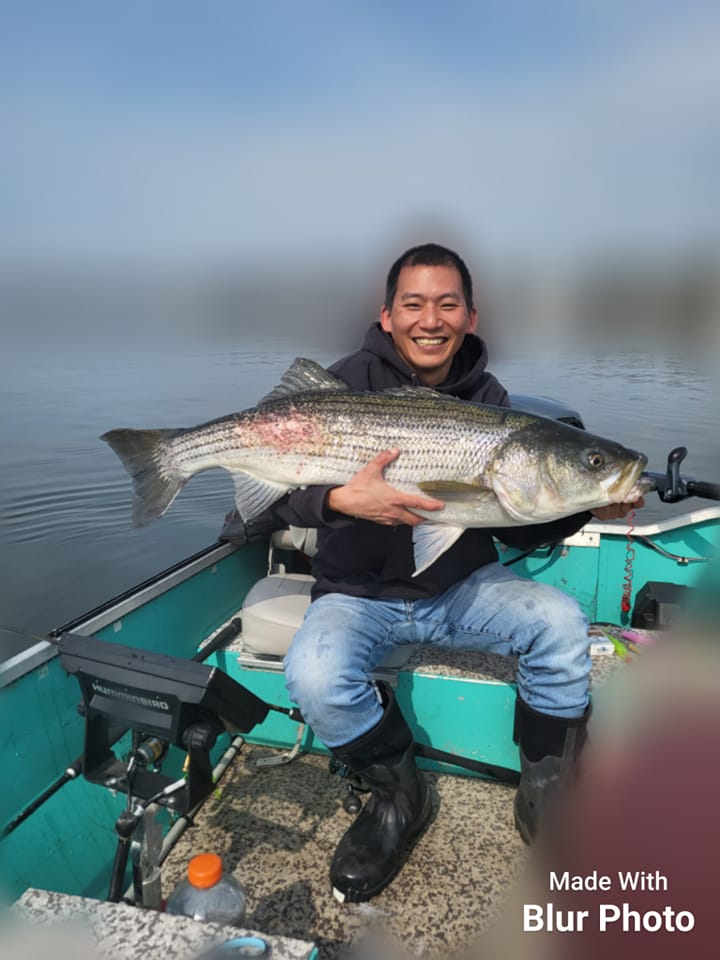
Capt. Jim Freda reported good striper action from his Shore Catch last week, including some big releases such as the one shown that sports the big belly full of roe to be shed later in the month in the Hudson River.