 by
by A study by the National Marine Fisheries Service of recreational pelagic species catches along the Atlantic coast has shown them to be arriving earlier and going further north as waters have warmed
“
“A new study by NOAA Fisheries has identified shifting distributions of Atlantic Highly Migratory Species catch, including tunas, billfish, and sharks, off the northeastern United States. The findings are part of efforts to better understand the effects of climate change on marine species and the fishing communities that rely on them.
“Shifts in the timing and location of Highly Migratory Species catch have important implications for recreational anglers, including seasonal fishing tournaments, and coastal communities that rely on these fisheries,” said lead author Dr. Dan Crear, Marine Spatial Ecologist, NOAA Fisheries HMS Management Division. “Fishermen may have to travel farther and/or fish earlier in the year to find certain target species. The species found at a favorite fishing spot may be changing over time, with species typically found further south becoming more common in northern waters earlier.”
“It was striking to see the extent of shifts in the catch for some of these species over the last 20 years,” said author Dr. Tobey Curtis, Fishery Management Specialist, NOAA Fisheries HMS Management Division. “Fishermen are observing these changes in fish distributions, and adapting to these shifts.”
The study used recreational fishery data collected as part of NOAA’s Large Pelagics Survey to explore the locations and timing of HMS recreational catches from 2002 through 2019. Recent studies are finding that HMS and other species in the region are generally shifting northward along the coast and arriving earlier in the year as ocean temperatures warm. These behavioral shifts are now reflected in HMS recreational catches, according to this current study. For example, catches of large and small bluefin tuna were found to be shifting northward at a rate of 4–10 kilometers (2.5–6.2 miles) per year.
The spatial shifts appeared to be related to the increasing water temperatures across the study region, which spanned from Maine through Virginia. Recreational catches of blue sharks and thresher sharks are shifting northward at rates of 30–40 km (19–25 miles) for each 1°C increase in water temperature.
The survey collects data from June through October each year when most offshore recreational fishing occurs. The study found that catches for most HMS have been occurring earlier in the season over time. For example, early bluefin tuna catches off Massachusetts in 2019 were estimated to have occurred 80 days earlier than in 2002. Similarly, early blue shark catches were estimated 66 days earlier off Connecticut, and early blue marlin catches were estimated 27 days earlier off New York. “
It’s interesting that NMFS hasn’t noted that their prediction that warmer waters would bring red drum to the north has not occurred even though (as my readers are aware) that species was the most important inshore game fish in central N.J. over 100 years ago when the Barnegat area was considered to be the channel bass capitol of the Atlantic coast.
Though there have been incredible catches of tautog off Maryland this year, tog anglers in NY/NJ Bight rarely see such specimens. Yet, two were reported on Belmar party boats this week,
One roe-laden female was released Wednesday on the Ocean Explorer by Davy and estimated in the upper teens tough there was no weight given or even the measurements with which to compute a widely-accepted weight by formula. A great move by Davy, but Ocean Explorer customers should take up a collection for a scale and tape on that boat;
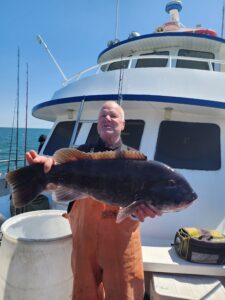
The other outsize tog was an 11-pound. 14-ounce black on the Big Mohawk by “Dave”.

The forecast is for east winds at just 5-10 knots before increasing to 10-15 in the afternoon.
Chuck Many is in Hilton Head, where he and Greg waited out the cobia before spotting one under a manta ray.

 Tight Lines
So it’s not overly restricted size and bag limits, they say. BS I say!
Sent from my iPhone
>
LikeLike